
This is general fashion and lifestyle information. Fit, comfort, dress codes, budgets, and beauty routines are personal. Verify product measurements, materials, care instructions, and return terms before buying.
A useful closet audit checklist produces a few decisions you can act on: what works now, what needs a specific care or repair check, what needs another outfit trial and what may be ready to leave your wardrobe. It should not turn into a compulsory item count or a shopping list built from someone else's life.
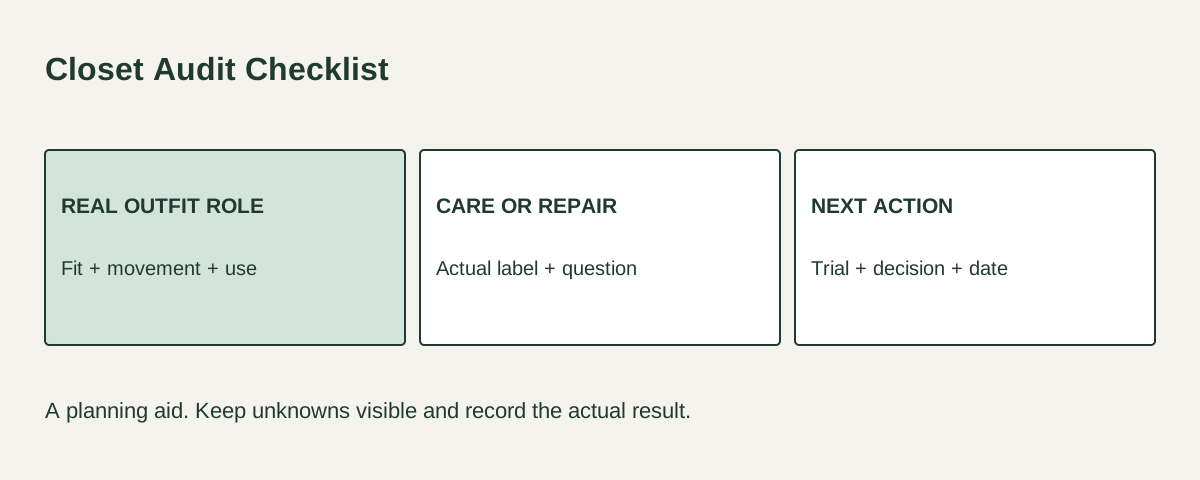
Use the original closet decision record for one manageable group of clothes. Record what you observed, the outfit role, the unresolved question and the next action. You can stop after that group; there is no need to empty the entire closet to make the exercise count.
Start with the next real set of days
Choose a small, relevant starting point: work trousers for the coming week, warm layers for the current weather or the clothes you reach for on ordinary weekends. Name the activities, comfort requirements and available care time before judging the clothes.
Keep occasional-use clothing in context. A coat, formal outfit or specialist work item may have a valid job even if you have not worn it recently. Time since last wear is an observation, not an automatic instruction to discard something. Sentimental pieces can also have a separate storage decision without being treated as everyday outfit failures.
Set aside a place to record questions. The purpose is to make fewer vague decisions, not to finish with several unlabelled piles waiting indefinitely on a chair.
Give each selected item a specific check
Try the item only where that helps answer the question and is comfortable for you. Use the shoes, layers and ordinary movements the intended outfit requires. Fit is about how you want to wear the garment now, not a grade assigned by its label.
| Check | Observation to record | A useful next action |
|---|---|---|
| Current use | A named activity where you want to wear it | Keep it accessible for that activity |
| Fit and movement | The exact restriction, adjustment or preference | Try a different combination or ask about an alteration |
| Condition | A loose button, open seam or other visible issue | Assess a specific repair before assuming it is simple |
| Care | The actual label and any unclear instruction | Check with the manufacturer or an appropriate cleaner |
| Outfit connection | Which existing pieces complete the outfit | Test the combination before naming a buying gap |
| Duplicate role | Which similar item you choose, and why | Keep a useful backup or reconsider an unused duplicate |
Do not treat the table as a scoring system. A failed button and an unsuitable silhouette are different problems. Writing down the exact issue helps you decide whether the next step is a small repair question, a different outfit or no further action.
Separate a repair idea from a repair commitment
An item marked “repair” needs more than a hopeful label. Write what needs assessment, who could assess it, the likely route and when you will decide. Do not assume a fabric, lining or construction can safely tolerate a home repair because the visible fault looks small.
Care also belongs in the decision. 16 CFR 423.6, published by Cornell's Legal Information Institute, sets out care instructions and a reasonable-basis requirement for covered textile apparel. It does not supply a new care method for an unidentified garment. For your audit, record the label that is actually attached to the item. Do not invent washing, ironing or solvent instructions from the fibre name or colour alone.
If the instructions are missing or unclear, keep that uncertainty visible. The checklist does not authorise a treatment. A garment waiting for a professional answer is not yet ready to return to your everyday rotation.
Test an outfit before calling something missing
Choose one item you want to use and build a complete outfit from what you already have. Include footwear and the outer layer needed for the real day. A top that seems difficult alone may work with a different bottom; an outfit that only works without the coat you need may still have an unresolved gap.
Our busy-morning outfit formulas can help with that separate assembly step. For the audit, save the particular combination you actually want to repeat rather than copying a formula as a new buying requirement.
Here is an illustrative decision: you have two similar trousers, but choose one because its care routine fits your week. The other might still serve a different season or a useful backup role. If it does not, record that fact before deciding whether to keep, alter or pass it on. This is a comparison you make about your clothes, not a claim that one fabric is universally better.
Keep uncertain items out of the immediate shopping list
Use “try again” when the next question can be answered: test with a different layer, check an alteration or revisit it for the relevant season. Write a review date or trigger that fits the question. Do not use an indefinite maybe category as another storage system you cannot see.
When an actual gap remains, describe its job, the pieces it must work with and any care constraint. Check the items currently in cleaning or repair before buying a replacement. A gap should survive those checks rather than appearing because everything usable is temporarily unavailable.
If the audit becomes a physical reorganisation job, use the closet-rail reset after making the decisions. Moving hangers and deciding what earns a place are related but different tasks.
Close the audit with one completed handoff
Return usable items to an accessible place. Give a repair question a real next step. For items leaving the wardrobe, check the recipient's or local service's current condition and acceptance requirements; do not assume an unwanted garment is suitable for donation or accepted by every textile scheme.
Save the brief record where you will see it before shopping. Review the decisions after the next relevant wear or completed repair, rather than auditing the whole closet again immediately. Sources checked 15 October 2026. Style & Kin has not tested this checklist's effect on spending, wardrobe size or getting-ready time.